Vanagon Redwoods

Vanagon Redwoods

Sunday, May 7, 2017

Van Weight

There are a ton of upgrades available to Vanagon owners nowadays and I certainly am interested in adding quite a few of these to my van as well.  I have an upgraded power plant that pushes my van along with lots of power, so I don't worry about the weight so much with regards to making it go.  I can put 4 people and a ton of crap in there and still cruise up into the mountains at 70mph.  However, stopping and turning must still be addressed.

I've spent a ton of time to make my brakes work the best they can, and they do.  I can lock them up if need be, but I typically drive as if I can't, in other words, I give plenty of space to cars in front of me and always assume that someone is going to give me a reason to slam on my brakes.

I've also added HD sway bars and better springs to help with the handling and it can swerve better than a stock van with less risk of a rollover.

I've seen a bunch of vans out there loaded to the gills with all kinds of "stuff" and I don't always get the impression that they've thought about weight distribution and how it affects handling.

Question:
Did you think about weight distribution when you loaded the van, keeping heavier items down low and lighter items up high?  This comes into play with regards to cargo pods and stuff that is your cargo tray and on your rack.  
Weight behind the rear wheels can affect your rollover potential drastically, so it's best to avoid heavy items to the rear, and always keep weight as low as possible.

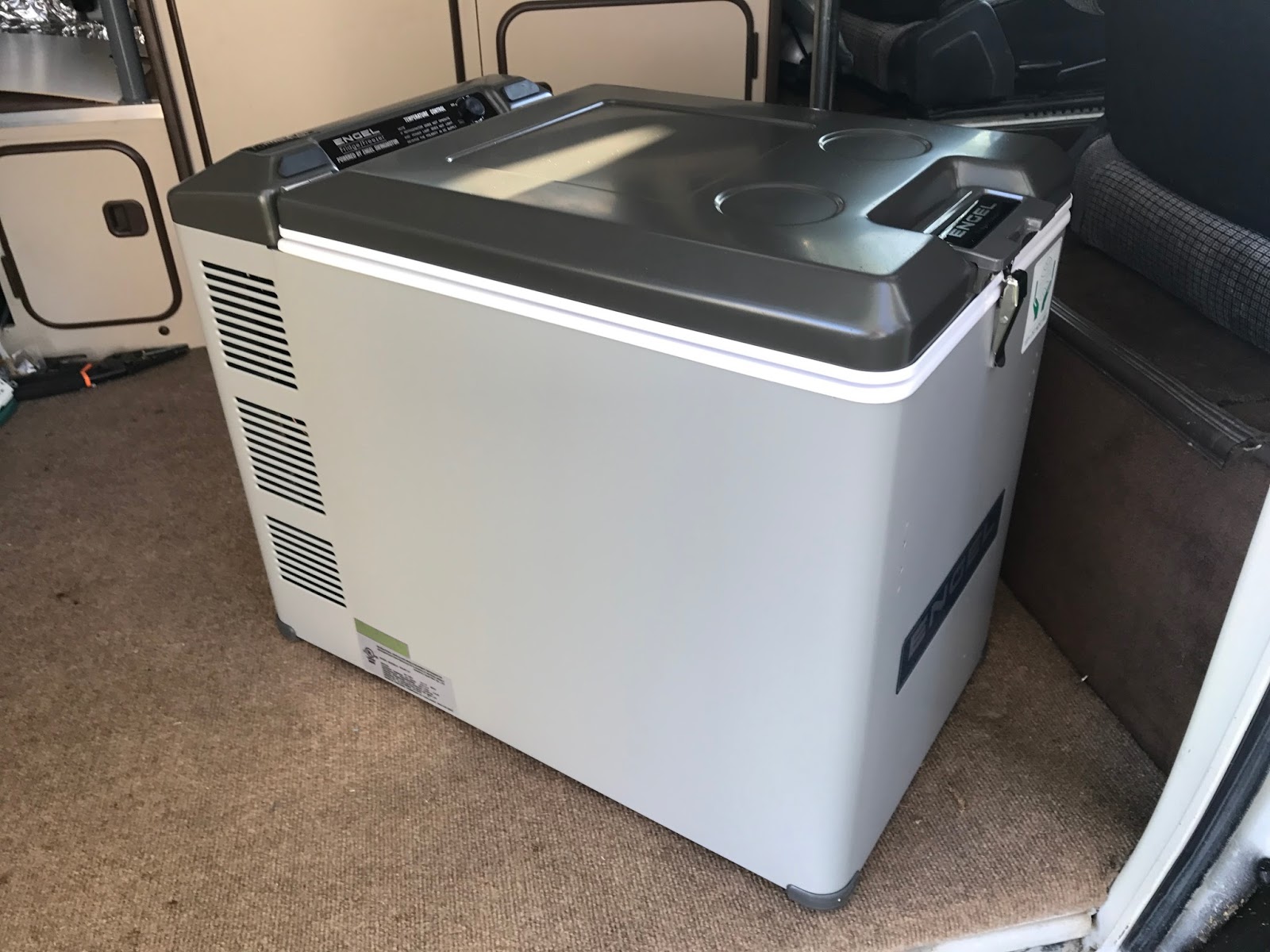
In the case of a rollover, is your cooler or other heavy items secured in a way to prevent it from flying around and hitting your passengers?  You'd hate to see one of your children get hospitalized because of a head injury caused by a box of ?? that was laying on the floor.   It could happen. My Engel Fridge weight about 50lbs empty.  I was sure to strap that thing down to protect my son who sits just a few feet behind it.

Enough of the darkness and doom.


With regards to braking forces... I try to think of my Van as more of the "backpacking" version of camping, so when I research new products, I try to take weight into consideration.  I try to keep it light and not carry unnecessary stuff, water, etc.  It requires more planning sometimes, but worth thinking about.  An ounce of prevention is worth of pound of cure in this case. 

For instance, if you're road tripping with other Van folks, check and see what they are bringing.  It might make sense to collaborate so that you're not doubling up on things just to "be prepared".  On my last road trip, there were a few tools I didn't toss in because I knew that my buddy had his and vice versa.  Water is heavy, so you might not need to fill your tank completely.  Is there water where you are going?  I got rid of my stock tank and installed a 6 gallon portable jug and I carry an extra 4 gallon jug sometimes when I think I'll need it.  Haven't run out yet.

I've seen guys put 6 gallon containers of fuel up on their roof. 6 gallons of fuel is about an additional 50lbs of weight up high that is going to help put your van on its side when you swerve to avoid the dog.  I know it sounds cruel, but I'm going to hit the dog and not take the risk of of hurting my family should that ever happen.

I drove commercial 15-passenger vans for about 8 years and the one thing you learn, is don't swerve unless you have to.  Eventually, the company I worked for moved away from 15 passenger vans because of all the reasons listed above.  We were always very careful not to overload the rear of the vans with weight.  There's tons of information online about passenger van rollovers and safety, much of which can be applied to our beloved Vanagons.  I suggest to troll around on the intrawebs and take some notes.  I hate seeing posts from people who have learned the hard way.

These vans are awesome, but lets not forget that they aren't modern 
sportscars and need a little extra attention when driving.

Some reading/resources:


Thursday, May 4, 2017

Front End Rebuild

After I finished my engine conversion a few months ago, we took the van out for a shake-down overnight road trip.  I was super excited to get it out on the highway and see how it performed.  We got everything packed up, met up with our friends in their Vanagon "Sedona", and then hit the highway.

The initial acceleration up to 60 was amazing and I continued to bring it up to highway speeds (65-70) and started to feel some shake in the front end, coming through the steering wheel.  It continued from 65 on up regardless of the speed, unless I was in a long curve, in which case, it would go away.  So, we proceeded on our trip and I just drove a little slower to minimize the wheel shake.

After the weekend, I crawled all around under the van and made a short list of what I needed to order.  My initial thought was:
-Tie rod ends
-Steering rack bushings and boots
-Upper ball joints
-Wheel bearings

My upper control and lower control arm bushings, as well as radius arm bushings were in pretty good shape, so I ruled those out.

I knew that my tie rod ends and steering rack bushings were shot, so I figured these parts would take care of the problem.  I had also planned on doing new springs and shocks at this time, so I knew that I'd be getting a new alignment and wheel balancing after the work was done.

So, I dove in.
diving in
I did the front end first: Tie rod ends, new tie rod boots, steering rack bushings, upper ball joints, springs and shocks, then the rear as well.  If you haven't worked on springs before, you should know that most of the time you can get a way with no spring compressor for the rears, but you'll definitely need them for the front.  I found that it also helps to loose the radius arm nuts a little, which allows the front A-arm to drop a little lower to get the springs in and out.  On my rear springs, I added a 1/2" spacer to compensate for the sag when the van is fully loaded.  You'll see a pic below of the van unloaded, and then loaded.  It sits slightly higher in the rear when empty.

While I had it all apart, I also pulled the rotors and drums and had them turned/machined and replaced the bearings upon their return as well as new brake pads all the way around.  I had addressed the rear shoes a few months back as well as brake cylinders because they were leaking.
disassembly process
The rear bearings on these vans are pain in the butt.  You have to pull the hub which involves using a large breaker bar and a 46 mm socket or the EMPI tool and a lot of force.  You also have to remove the brake assembly (but you don't have to disconnect the brakes, just move them aside) and then 4 bolts on the backside to release the hub.  It's a pain, and I don't recommend if for those that aren't handy.  I don't have pictures of the rear process because my hands were too dirty and bloody to grab the camera.  :-)
compressing/installing the new springs (front)

new rear springs and shocks


All of this took me about 2 days and it went pretty well.  It also helps to spray PB Blaster on the nuts/bolts that you'll be removing. I typically do it a day or so before so that it has time to settle in.

Once I got everything put back together. I took it in to get the wheels balanced and front end aligned.

I picked up the van, and took it out for a spin...

Got it up to about 65 and guess what?  It still had a shake in the front end?  Damnit.

So, I went back into the alignment shop and talked to them.  My contact there is super cool and he knows his stuff.  He thought maybe I might have a bent wheel, but he had his alignment guy re-check everything and do "perfect balance", which in their secret code, means, take the time and do whatever it takes to make this vehicle roll perfect.

So, they did.  I picked up the van a few hours later and the problem was solved.
So, what was the problem you ask?

My wheels are aftermarket Ronal R9's.  They are cool wheels that I picked up a while back and all balancing weights had been placed on the inside of the rim.  Well, apparently, that's the preferred way to balance a wheel unless it's having some issues, in which case you can then add weights to the outside.  So, that's what they did and solved the problem.

In retrospect, I didn't need to do ANY of the front end work to get rid of the shake, however, I had planned and wanted to anyhow, just so I could rest assured that the van was safe and riding as good as possible.  It was on my list of things to go through during the "rebuild" anyhow.

Also, when I picked up the van, the alignment shop let me know that the tires I had on the van were not up to par with regards to load rating and that I should consider replacing them.  I made the decision to go ahead and replace them with a larger all-terrain tire.  I chose the Yokohama Geolandar A/T in a 215 75/15 and have been extremely happy with them.
New suspension, tires, etc.
New Yokohama Geolandar A/T's
Van fully loaded in Death Valley
So, we did our road trip.  9 days, 1600 miles and a ton of backroad/washboard driving in Death Valley, then into Nevada, Utah (Zion, Bryce, Kodachrome) and back.  The van performed AMAZING.  It rode great, handled great, had tons of power and I couldn't be happier.  We didn't have any problems whatsoever during the entire trip.  I did find a small rattle in the front end, that I think is steering box related, but it didn't affect the steering or handling of the van.  I'll be addressing that soon to figure out what it is.

Parts installed during this upgrade:
-Schwenk Springs
-1/2" Spring pads (rear)
-Koni Adjustable Shocks
-Upper Ball Joints
-Steering rack bushings
-Tie Rod ends
-Tie rod boots
-Wheel Bearings (all 4 wheels)
-Brake pads (front)
-New tires (Yokohama Geolandar A/T's (215 75/15)
-and I had all drums and rotors machined

"Sedona" & "Ferdinand", outside of Bishop, CA


Tuesday, May 2, 2017

Auxiliary Battery Install

Ferdinand is running good and ready for some excursions, yet I still have many small projects to attend to (and always will).  One of the most recent upgrades stemmed from my wife buying me an Engel MT-45 portable fridge for my birthday.  Awesome gift, especially since we were getting ready to do a 9-day road trip in the van.  However, I knew that our standard car battery setup was not going to suffice and that I needed to make some upgrades. My Westy is an '82 and did not already have an Aux battery installed, so he was a blank slate for the most part.

I had been researching this for the past few months, and had settled on a setup that I ran across online from Ken Wilford (you can find a video he made on Youtube).  He utilized a few smaller 12v, 22Ah wheelchair batteries that fit perfect in the box beneath the drivers seat, in fact, you can fit 4 of them in there.  These are a sealed, lead acid battery and you can find them on Amazon for about $35-40 each and free shipping.  I chose to start with 3 because that affords you a little extra space under the seat to mount your relay and run wires a bit easier.  I figured that I could always add one more later if my energy demands are too high for this setup (see next paragraph).  I also have an empty spot under the passenger's seat for yet more batteries in the future because my engine battery is now located under the rear seat.
UB 12220, 12v 22Ah.
I bought mine on Amazon
Next, figure out your energy demands and battery needs.  You begin by figuring out what you plan to run off of your Aux battery setup.  Lights? Stereo? Fridge? Sink Pump? Inverter? Other?  Then make a list and try to calculate/log what each of those devices will draw per hour.  This will give you a number to start with.  The calculations from this point on get a little more complex, and I'm no expert, so I would recommend referring to various websites to help explain it.  I will however post below the quick calculations that my friend drew up for me and my application so you can see what I did.  The particular setup was done somewhat temporarily for our 9-day trip, knowing that we were not going to be sitting in any one spot for more than 3 days, and it worked perfectly.  I also didn't want to spend the extra money on a solar panel that I may or may not need.  I already had a smaller one in my possession, so decided to start with that.


The smaller batteries are wired in parallel, which keeps the same voltage and adds the amperage, so 3 of these 12v, 22Ah batteries wired in parallel, will equal 66Ah, but remain at 12volts.
 Here's a quick reference to how they "should" be wired to help equalize the load and charging on the batteries.
The pic of mine below is not wired for best longevity/performance, but has since been remedied, see if you can find the problem. Disregard the red wires on the negative side.  I had lots of red wire, so decided to use it up.
Located under the driver's seat
So, once you've got the batteries, you'll need to think about how you're going to charge them.  I purchased the Aux Battery charging kit from GoWesty, which is essentially a large solenoid/relay, a fuse and some wires.  What this does, is it isolates your aux battery when the key is off and separates them from your car battery so that you don't drain your main battery when camping.  When the ignition is turned on. the relay connects both batteries so that the alternator is charging everything.

I also chose to install a small solar panel up in the cargo tray to help extend the life of the aux system when we're camping.  It's a small panel for now, but I plan to add a larger one later for extended life.  My small panel is approx 16"x16" and acts like more of trickle charger.  On our last trip, I was able to run my fridge (and sink pump occasionally) for at least 3 days.  I still have my radio wired to the car battery, but we use a bluetooth speaker connected to our phones for music anyhow.
If you're using a solar panel, you'll need a controller.  The one in the picture below, runs about $25 online and offers 2 USB ports for charging your devices. Works great, but is slightly hard to read the screen in the location that I chose.  Just something to think about if you buy this one.

I also put in a fuse block so that I can add on more things as time goes on.  I've since wired in a cigarette lighter port for my fridge to plug into.

This setup was done pretty inexpensively and cost me about $180 total all said and done (batteries, controller, aux wiring kit and solar panel).  You can spend more and probably less, but that's what I paid and am happy with the results.

There are many different ways to go about this and you'll read about folks who run utilize huge solar panels and enormous battery banks.  It's really up to you and your needs.  For what we do, this works great.

Wednesday, February 1, 2017

Tank Contaminates

If you read my post regarding the Subaru swap, you know that I had some issues with the tank.  I thought I'd elaborate a little more here so that hopefully nobody else gets caught up in that mess.

My van is/was an 1982 Diesel.  The fuel tank is 35 years old and until recently, had never been resealed.  I bought a seal kit a few months back and tackled the job.  It requires dropping the tank and replacing 3 small rubber grommets, one large grommet for the filler neck and the o-ring that goes under the sending unit.  My filler neck grommet was bad and I couldn't fill the tank without it leaking.
VanCafe's reseal kit "B" with the metal fittings. I used the plastic version.


Replacing all of these is pretty easy, but dropping the tank can be a pain, mainly due to all the expansion and evac lines that run to it.  I've now got it down to a system and can drop the tank in about 15-20 minutes.  It just takes some practice.  The crossover tube is by far the most difficult to re-install, but it helps to remove the strap that hold it up so the floorboard of the van.  I now leave mine off.  Also, I've found that if your spare tire is removed, as well as the clam shell, you can access the driver's side part of the crossover tube a bit better, especially if your hands are big.  I have trouble getting my arm/hands in above the shock tower, and then when I do, I'm limited on movement.
Crossover tube/fitting on the driver's side.
So, when I replaced the grommets, I inspected the tank and everything on the inside was smooth and clean with a nice coat of diesel fuel inside of it.  Diesel is really an oil, so it protects thing nicely.

My new motor is a gasser, so when I installed it this month, I removed the tank again, and emptied and rinsed it out with gas.  I added a few gallons of gas, shook it around, tipped it up and down and tried to free up anything that I could.  I figured that the tank was now ready to accept gasoline on a regular basis... so I thought.

After the conversion, I added fresh gas (approx. 5 gallons) and got the motor running.  It ran great.  After getting everything dialed in and road-ready, I took it out for spin and it starting loading up/bogging down.  It did it a few times and then eventually stalled.  I recognized the issues as fuel related, so I dropped the fuel pump and filter and immediately saw crud on the inlet side of the pump.  I took the outlet hose off the tank and nothing flowed out, and when I could get flow, it had a bunch of silt in it.

So, I dropped the tank again and inspected the contents.  Full of crud and the inside walls/bottom were nasty with all kinds of "junk".

Looking in through the sending unit port.  The 3 marks are where I scraped some samples with a screwdriver.


The "fresh" unleaded fuel that came out  :-0
So, I've deduced (without too much research), that the gasoline has eaten away and loosed up anything that was in the tank or in the bottom catch basin that had built up over the last 35 years, and it was now all loose and ready to flow into the fuel system.

Luckily, my fuel pump and filter caught it all I'm pretty sure the injectors never saw much debris coming their way.  I'll probably inspect those next and run some injector cleaner through the first few tanks in my brand new fuel tank.

I ordered a Spectra VW3C tank from Amazon a few days ago and it's scheduled to arrive today.  I did some research and it "appears" that most of the distributors/resellers are sourcing the same tank.  There are numerous threads about this on TheSamba.  I opted for Amazon because we have a prime account and the shipping was free.  I cringed at the $40 shipping costs from my favorite Vanagon suppliers and decided to chance it with Amazon.  I've read good reviews on the Spectra tank and don't anticipate any problems with it.  I fully recommend ordering from the Vanagon specialists when possible, but after having just spent $1000000000 on my conversion, I'm feeling cheap for at least a week or two.

Tank Differences:
If you ARE replacing your tank, you should be aware that there are 3 different types of tanks.  The main difference is the size on the filler tube hole and the outlet fitting.  My diesel tank had approx a 74mm filler hole, which I think was common for 1980-83, then it got smaller in 84-85 and even smaller from 86-91.  Just double check what you need.  Filler necks are easily swapped, but also hard to find.  I upgraded to the newer style tank because it also has a 12mm outlet, which allows more flow and also mates up nicely with the fuel pump which has a 12mm inlet.  However, I had to find a newer style filler neck made of plastic, but it also comes with an anti-siphon valve on the end.
Newer style filler neck (plastic)

the New Tank arrived (Spectra VW3C).

Van Cafe has a nice write-up on the difference of the filler tubes and how you can tell the difference.

Friday, January 27, 2017

Subaru Conversion Complete... mostly


I had high hopes of blogging my way through the process of this conversion, but I got so wrapped up in it, I didn't have time to write down a word.  So, I'm doing my best to jot down a quick re-cap on the last 3 weeks of my efforts.

Here's the project in a nutshell:
1982 Diesel Vanagon "Ferdinand" converted to a 2001 Subaru Engine:

Ferdinand the Van
It took me a total of 23 days from start to finish (granted I'm not exactly done), but I took about 3 days off in the process.  I'm a merchant mariner and am home usually for 30-40 days straight and can commit to full days on projects like this.  I don't recommend doing it this way because you'll get burnt out, but I managed to knock it out in about 145 hours.  It was some long cold and wet days, but I managed to pull it off.  Having a supportive and "understanding" wife is helpful.  She understands the importance of our van in good solid "road trip worthiness" and was all for the project from the beginning.  I pulled some long days under the van, and having a nice bowl of soup or something ready for me when I came in, was amazing to say the least.

PARTS:
I ordered up the motor and most of the parts during my last "at sea" work phase so that they'd be ready for me when I got home.


motor and trans mated up
-The conversion kit came from Rocky Mountain Westy, as well as a new radiator and a few other accoutrements including Schwenk springs which I have not installed yet.

-The wiring harness and motor came from the donor car at the local subaru wreckers and was re-wired by Rocky Mountain.  They did a great job and everything worked the first time.

-The motor (SOHC 2.5) was from a 2001 Subaru Legacy GT was to be "reconditioned" with new head gaskets, timing belt and water pump.  More on that later.

-The transaxle came from a local wrecker who has lots of vanagons and I had it rebuilt and regeared from a local trans expert who specialized in VW transaxles. I changed 3rd gear to a 1.14 and 4th up to .77.

-The remaining parts of the puzzle came from GoWesty, VanCafe, RSFab (Big Shot Shifter), etc.
Subaru Conversion Kit from RMW

Here's some of the stumbling blocks I encountered along the way.

RAIN!  California had record rainfall this January and since my van doesn't fit in the garage, I was working on the side yard with a small carport that covers only half of the van. I used a large EZ up when possible to keep me dry.

COLD:  When it wasn't raining, we had some 30 degree mornings that slowed my bones a little.  I'm 47 years old and I don't move like I used to, so needless to say, the coldness took its toll. Thank goodness for my propane heater that puts out some serious BTUs.

I didn't originally plan on replacing all of the cooling system, but came to realize that the diesel had smaller diameter coolant lines, which then led to a replacement of the radiator as well.  Since you can't find replacement radiators for diesels too easily, I upgraded to a newer model and had to source the mounts from a newer van and fan shroud and order some new hoses in the process.  I also had to rewire the fan sensor on the radiator. Not difficult, just time consuming.

Getting the harness in was pretty easy, although getting tucked and placed properly took little time and patience.  I just had to solder a few wires, run a few others and connect a few things here and there.  Super concise instructions from Rocky Mountain Westy and it all went pretty smoothly. They had awesome turnaround on the harness by getting it back to me in about 2-3 weeks.

My shift linkage would not work with the new trans and so I then had to source a whole linkage set up from a donor and replace all that as well, then replace shift balls on the trans, etc.

figuring out the wiring harness
I opted to use a Bosch starter from a VW TDI Golf and an adapter plate that I purchased from Rocky Mountain.  This starter has more torque and turns the engine over quicker than the stock vanagon starter.  I sourced the starter from a local wrecker with a warranty.

Once the harness was in and the motor/trans were mated, it was time to install.

The install went pretty well.  We busted that out in about 4 hours (3 of us) and it lined up pretty good and solid with only minor mods to the van itself so that the carrier bar would fit nice and perfect on the frame rails.  The rest of the connections took time and a few more parts orders.

Mounted up in the van
fellow Subie-Vanagon friends helping with the install
Once I got everything plumbed with new stainless coolant lines and heater hose I had to get all the electrical connected and secured. Then it was on to shift linkage, accelerator cable, brake booster lines installed and the fuel system to include the evac canister, fuel pump/filter and the tank.  Pretty straightforward, but time consuming work. I also had to locate and source a few sensors because I neglected to get them from the donor car, but pretty easy to find at the local wreckers.

Stainless Steel Coolant lines
Diesel vans don't have typical fuel systems, so I had to install a fuel pump and filter as well as a charcoal evac canister and flush my tank completely (more on that later).

Then I had to add on the RMW exhaust system (extremely sexy parts btw) and get my battery connected up.  I moved the battery from the engine bay to under the back seat.  Pretty simple process, just time consuming.  I plan on adding an auxiliary battery and solar panel later as well.
laying out the exhaust parts

Exhaust Installed


Battery and ECU under the rear bench


Intake/Air Filter
I spent one evening trying to get my shift linkage dialed in with the new Big Shot Shifter from RSFab, but come to find out my shift ball on the trans was shot, so it was back to the web and more parts orders.
Big Shot Shifter from RSFab
bad ball
I also completely disassembled my axles and CV's in the process and ordered new Lobros after realizing mine were shot.  I put on Rockford boots in the process and packed everything with Redline grease.
Realization of everything being toast

New Lobro CVs and Rockford boots ready to go.


Trans/Axles/Linkage
After the axles were in and torqued to spec, I had to solder in a resistor to my coolant gauge so that it would read correctly.  I used a 33hm resistor, however I think I might switch to a 22ohm since now it reads a little on the cool side when temps are at normal range.   I didn't add a tachometer, but instead ordered a OBD2 bluetooth dongle and an app for my iPhone that shows all the engine's vitals.  The app (Dashcommand) and the the Bluetooth dongle I'm using is the GoPoint BT1 for Apple and it works great. I just need to get in there and fine tune the readout to that it's pertinent to my needs.  You can also download various other dash layouts from certain cars. I have an old iPhone that I plan to leave in the van for this purpose.
DashCommand App
So, after everything was installed and ready, I filled all my fluids, primed the oil pump and fuel pump, and gave it a few cranks.  Turned over fine, but no fuel delivery.  The fuel pump that I had was used, but working fine when I bench-tested it.  Once I installed it however, it decided to crap out.  So, my friend brought over his spare and we installed in within a few minutes the motor fired right up and purred like a kitten.

We spent about an hour on getting the cooling system bled and then called it a night and everything seemed groovy, no drips or anything.
The next day, when I fired it up, I noticed a small drip of coolant from underneath that progressed throughout the day.
coolant leak coming from the water pump
After a little inspection, we concluded that the water pump was leaking through the weep hole and that the pump had not been replaced as part of the original agreement with the wreckers.
So, then after sulking a little and talking with the wreckers on how to remedy the situation, I decided to continue the rest dialed in until I can replace the water pump. The wreckers offered to do the water pump install for me, but I'm a little hesitant after installing all my custom exhaust around the timing cover.  I'm just afraid that they'll hack it up or something.

So,  I got the van ready to test drive and pulled it out onto the street.  We went for a ride around the block and it seemed to really want to go with plenty of smooth power, until I hit 2nd gear and the motor bogged down. Fuel delivery problems again.

After a little inspection of the pump and filter, I realized that my tank, originally a diesel tank, had some good gunk in the bottom that was now breaking up with the gas that had been sitting in there for a few days at this point.  Even though I rinsed it out the best I could with fresh gas a few weeks ago, the crud wasn't letting loose until the new gas had time to eat away at it.  

So, now I plan on putting in a new tank instead of messing with the old one any longer.  However, I'm scheduled to go back to work in a few days for a 30-40 day hitch and am not going to spend any more time on the van until I return.
We had planned on taking the van down to a Vanagon meet-up in San Francisco this weekend called "Burning Van", but its not ready and we'll be attending the event with some friends in their van instead.

Once I return home and can work out the kinks, "Ferdinand" will be an awesome little runner and weekend adventure vehicle.  For now, he's just a side-yard dust collector with really nice parts underneath. 


Tuesday, January 3, 2017

Subaru Conversion: Day 1

I figured I'd log some recaps on my progress, mostly to remind myself what I've accomplished each during during the Subie conversion.

A brief back history.

I picked up "Ferdinand" in June and he's an 82' Diesel Vanagon camper.  I wanted a diesel so that I don't have to deal with smog and can go down whatever road I'd like with regards to motor conversion.  After getting him running and driving, I soon realized how slow and underpowered the diesel 1.6L engine really is.  After much discussion with my travel partner (my wife), we agreed that Ferdinand needs a new power plant.

2 months ago, we figured out the financial part of it and began getting our heads around what it will take to convert the van to something a bit more modern.  I researched 1.8t, TDI, M-TDI, Subaru and even upgraded VW waterboxxer motors, but settled on the Subaru 2.5.

I have 3 good vanagon friends, all with Subaru conversions, so the support is strong.

So, last month, I put a deposit down on an engine, to be be reconditioned with new head gaskets, timing belt/water pump/etc.  Then I found a transaxle (stock diesel trans won't work... geared too low and slightly different).  Then started to research conversion kits.

I chose Rocky Mountain Westy for my conversion parts because their product looks amazing and they were the only company that went above and beyond to answer many questions via phone, email and Facebook.  Taking on a task like this is daunting, and I wanted to work with a product that has good support to follow, and they've kept up their reputation quite well.

I'm home and off work for the entire month of January, so it's game on!

So, today... I took delivery of my motor and rebuilt/re-geared transaxle.  The conversion parts arrived last week and my wiring harness is on its way.

Being that this is a diesel van, I have to take things a bit farther and swap out the entire cooling system because the coolant lines on a diesel are smaller, as are the radiator connections.  I also have to add a fuel pump, charcoal canister and a few other things.

I only managed to install the reversed coolant manifold and the motor mounts today after getting the engine home and into the garage and on the engine stand.  Everything takes time and the weather outside is nasty, so I haven't even dove into the van itself yet.  I'll write more about the process as I go for those that might be looking to do the same.


Thursday, November 10, 2016

Engine Upgrades

Well, Ferdinand has come a long way since June and he's working well.  I've managed to take him from being a shell in a field, to a fully running and (mostly) functioning Westy, albeit slow Westy.

The 1.6l diesel engine is a great little motor and I'm all about diesel, but VW didn't factor in the importance of "time" when they made this motor.  I enjoy driving it, and getting 30mpg, but it sure takes a great deal of time to get anywhere.  Just a few weeks ago, I had my son time us from a traffic meter on an onramp to see how long it would take to get up to 60mph.  1 minute, 20 seconds!  Amazingly slow.

Our intentions for this van from day 1, was to get him all working, driving and then slowly move towards a motor upgrade.  I've been researching since June on what will work/not work, the costs, the "time", longevity, ease of work involved, etc.

A few weeks ago,  came to the conclusion that the best route for us at this point in time, is to do a Subaru 2.5 swap into Ferdinand.  Then, as it happens, we did some car swapping and ended up being able to afford to take on the conversion project a little sooner that I'd anticipated.  So, I've nailed down all the details on the motor, the conversion, the transaxle and the when, why and how it will all come together.

The Motor:
I'm going with a 2.5 naturally aspirated SOHC motor from 2000-2004 and having it fully rebuilt here locally with new pistons, polished crank, etc... a full rebuild kit.

The Parts:
After talking in great detail with many people who have done this conversion, and endless emails and Facebook posts with manufacturers of various products, I've concluded that though all of the conversion kits/parts have their pros/cons, that I'm sold on the Rocky Mountain Westy package.   I really like to attention to detail on the parts and their service has been amazing.  I'm also very fond of the fact that their focus is mostly geared towards creating awesome products for the VW Vanagon.  Mike, Mark and Joe have been very helpful and easy to work with.  My parts kit will be ordered up within a few weeks and they should have my wiring harness in their hands around the same time.


The Transaxle:
I was originally going to pick up a gasser transaxle (diesel trans won't work easily with Subie) and get it rebuilt and re-geared before installation.   After much discussion about gear ratios, ring and pinion, tire sizes, RPM's, etc, I think I'm going to go ahead and install the stock gasser trans with the Subie, drive it a bit, settle in on a tire size and then re-gear accordingly.  Yes, I'll have to pull the trans again, but I think this is a better approach.  The 2.5 is definitely going to need a higher 4th and probably 3rd, but I may swap some tires around and don't want to commit to a certain ratio just yet.

Timeframe:
I have to leave for a work trip and won't be back until around Christmas, so my plan is to get everything lined up and begin the "production" right after Christmas and into January.  I hope to get it all dialed in before Spring rolls around so that we (my wife, kids) can get in some good road trips this summer.

Obstacles:
Being that I have diesel, there are a few things that need to get addressed.
1. The lack of a fuel pump... going to have to add one.
2. I need larger coolant lines as the diesel uses 1.5" lines and I'll probably swap out the radiator at that time.
3. Battery is in the engine compartment and I might try and leave it there if it doesn't hinder the motor.
4. Need to install a charcoal canister and vent the fuel lines into it.  Diesel tanks just vent under the body.

Little piddly stuff that just needs to get addressed, but all in all, it should go well.  I have 3 good friends, all with Subie 2.2 conversions who know the trials and tribulations of conversions, so I think I'm in good hands.

Definitely looking forward to having some power.  The stock diesel puts out about 55hp and the upgrade to 2.5 triples that, which means I'll also want to address the brakes and make sure I can stop all that mass.

I know that I'll probably get booted from the Vanagon-Diesel group once they read this, but a TDI build just isn't in the cards for us right now, especially since all my Van friends that are helping, drive Subie powered rigs.

Keep your eyes peeled for the process in a month or so and feel free to add comments below.